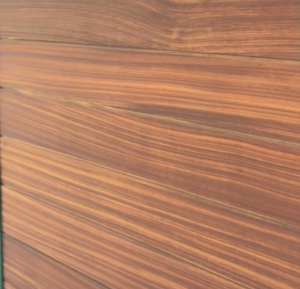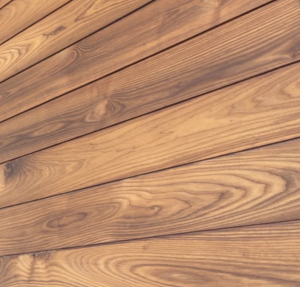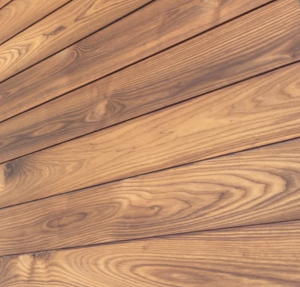

Ayous (Triplochiton scleroxylon), also known as Obeche, African Whitewood, Samba, or Wawa, is a lightweight tropical hardwood native to the forests of West and Central Africa. In its natural, unmodified state, Ayous has a pale cream to light yellow heartwood with a straight to slightly interlocked grain and a medium-to-coarse texture with good natural luster. It's frequently grouped with — and sold alongside — African Mahogany because of its similar workability, dimensional characteristics, and the way it accepts stains and finishes to achieve rich, mahogany-like tones.
Ayous is prized for several reasons that make it well-suited to architectural and millwork applications: it's remarkably lightweight (roughly 24 lbs/ft³), which eases handling for vertical siding, ceiling, and overhead installations; it has low shrinkage and good dimensional behavior once properly dried; and its clear, knot-free character grades produce a smooth, uniform surface ideal for high-visibility finish work. In its natural state, Ayous is considered non-durable to moderately durable against decay, which is why exterior applications require a quality penetrating finish to protect the wood and extend its service life.
Each board is finished with CUTEK® Extreme Clear, a penetrating oil specifically formulated to stabilize exterior wood from within. Unlike surface coatings that sit on top of the board and eventually peel, crack, or flake, CUTEK® carries its oils deep into the wood fibers where they work continuously to reduce moisture movement — the primary cause of cupping, checking, warping, and end-splitting. This is especially important for a species like Ayous, whose natural durability benefits significantly from a stabilizing oil. Because Cutek penetrates rather than films, maintenance requires no sanding or stripping — just clean the surface and reapply when it looks dry. The clear formulation adds no pigment, allowing the Ayous's natural cream-to-honey tone to show through initially before gradually silvering to a soft gray patina if left unmaintained with a colortone.
Because Ayous can react with iron and galvanized fasteners (causing black staining), stainless steel fixings are required for installation. Pre-drilling is also recommended, as the wood can be brittle.
Ideal for architectural siding, feature walls, soffits, porch ceilings, interior paneling, sauna applications, and covered outdoor living areas where a lightweight, workable hardwood with a refined appearance is desired.
| Spec | Detail |
|---|---|
| Species | Ayous (Triplochiton scleroxylon) |
| Also Known As | Obeche, African Whitewood, Samba, Wawa; often sold alongside African Mahogany |
| Origin | West and Central Africa |
| Modification | None — natural, kiln-dried |
| Finish | Cutek Extreme Clear (penetrating oil) |
| Finish Type | Oil-based, non-film-forming |
| Color | Natural pale cream to light yellow; darkens slightly with age; accepts stains beautifully to achieve mahogany-like tones |
| Grade | Clear grade available; virtually knot-free |
| Grain / Texture | Straight to slightly interlocked grain; medium-to-coarse texture; good natural luster |
| Janka Hardness | ~440 lbf |
| Average Dried Weight | 23.8 lbs/ft³ (380 kg/m³) — lightweight |
| Specific Gravity | 0.32 (basic), 0.38 (12% MC) |
| Modulus of Rupture | 8,680 lbf/in² |
| Elastic Modulus | 934,000 lbf/in² |
| Shrinkage | Radial 3.1%, Tangential 5.3%, Volumetric 8.7% (T/R ratio 1.7) |
| Natural Durability | Non-durable to moderately durable — finish required for exterior use |
| Workability | Machines and finishes well; sands smoothly; accepts stains and oils evenly |
| Applications | Exterior siding (with finish), feature walls, soffits, porch ceilings, interior paneling, sauna walls/ceilings, millwork, trim |
| Fixings | Stainless steel required — Ayous reacts with iron and galvanized fasteners; pre-drilling recommended |
| Maintenance | Clean and re-oil with CUTEK® Extreme as needed — no sanding or stripping required |
| Sustainability | FSC-certified options available |
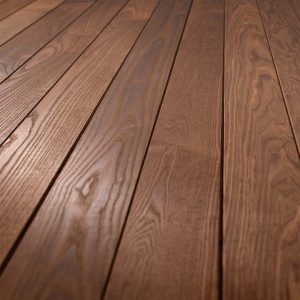
Thermac Ash Dark Roast is a thermally modified White Ash produced by Bingaman & Son Lumber from responsibly managed Appalachian and Pennsylvania forests. Like all Thermac products, the wood is transformed through a chemical-free process using only heat and steam — no chemicals, plastics, or additives — sustained in an oxygen-deprived kiln for 14–16 hours. The "Dark Roast" designation refers to a higher peak modification temperature, driving the wood to a deep, rich chocolate-brown tone that runs consistently through the entire board — not just on the surface. Because the color is a product of molecular caramelization rather than pigment or stain, the color cannot chip, scratch off, or reveal a lighter tone underneath: whenever the board is milled, cut, sanded, or worn, the same dark brown color remains.
The deeper thermal modification also pushes performance to its peak. Independent testing per EN 350 rates thermally modified ash at Durability Class 1 ("very durable"), on par with tropical hardwoods like teak and ipe, with an expected exterior service life of 25+ years when properly maintained. The high-temperature process breaks down the sugars and hemicellulose that fungi and insects feed on, and dramatically reduces the wood's ability to absorb moisture — cutting water absorption by 60–70% and dropping equilibrium moisture content to just 4–6% (versus 18–22% for untreated ash). This translates to radial and tangential movement under 1%, virtually eliminating the cupping, warping, and seam-opening that plague untreated ash in exterior use.
Each board is finished with CUTEK® Extreme Clear, a penetrating oil engineered to stabilize exterior wood from the inside out. Rather than forming a surface film like paint or varnish, CUTEK® carries its oils deep into the wood fibers, where they work continuously to slow moisture movement — the primary driver of cupping, checking, and end-splitting. Because the finish penetrates rather than coats, it cannot peel or flake, and maintenance requires no sanding or stripping — just clean the surface and reapply when it looks dry. The clear formulation adds no pigment, allowing the Dark Roast's deep chocolate-brown tone to show through initially before gradually silvering to a soft gray patina if left unmaintained with a colortone.
Ideal for high-end architectural siding, cladding, soffits, porch ceilings, feature walls, decking, and covered outdoor living spaces where a rich, dramatic dark-wood aesthetic is desired — offering the look of exotic tropical hardwoods with the sustainability of a domestic species.
| Spec | Detail |
|---|---|
| Species | White Ash (Fraxinus americana) — thermally modified |
| Product Line | Thermac by Bingaman & Son Lumber |
| Modification Level | Dark Roast — higher-temperature thermal modification for deeper color and maximum durability |
| Origin | Appalachian / Pennsylvania hardwood, USA |
| Modification Process | Heat and steam only, no chemicals; oxygen-deprived kiln for 14–16 hours at ~400°F |
| Finish | CUTEK® Extreme Clear (penetrating oil) |
| Finish Type | Oil-based, non-film-forming |
| Color | Deep, rich chocolate brown; consistent through full board thickness (not a surface stain) |
| Weathering | Silvers to gray patina over time if not maintained with colortone |
| Durability Class | Class 1 ("very durable") per EN 350 |
| Janka Hardness | ~820–1,325 lbf |
| Dimensional Stability | Radial shrinkage ~0.1–1.0%; tangential ~0.4–1.0% — significantly improved vs. untreated ash |
| Density | ~554 kg/m³ post-modification (roughly 12–20% lighter than untreated ash) |
| Equilibrium Moisture Content | ~4–6% (vs. 18–22% for untreated ash) |
| Water Absorption | Reduced 60–70% vs. untreated ash |
| Service Life | 25+ years in exterior applications with proper maintenance |
| Fire Rating | Class B/C flame spread achievable (ASTM E84) |
| Applications | Exterior siding, cladding, soffits, porch ceilings, feature walls, decking, trim, high-end architectural millwork |
| Fixings | Stainless steel recommended; pre-drilling advised near board ends |
| Maintenance | Clean and re-oil with Cutek Extreme as needed — no sanding or stripping required |
| Sustainability | Domestic hardwood from sustainably managed forests; chemical-free modification; sustainable alternative to tropical hardwoods |
Thermac Ash Light Roast is a thermally modified White Ash produced by Bingaman & Son Lumber, one of the leading domestic manufacturers of thermally modified hardwoods in North America. Sourced from responsibly managed Appalachian and Pennsylvania forests, the ash is transformed through a chemical-free process that uses only heat and steam — no chemicals, plastics, or additives — sustained for 14–16 hours in an oxygen-deprived kiln. The "Light Roast" designation refers to a lower peak modification temperature, producing a warm caramel-to-amber tone rather than the deeper chocolate brown of a standard or dark roast. The result is a domestic hardwood with the color character of exotic species like teak or light walnut, while retaining more of ash's natural grain contrast and figure.
The performance story is where thermally modified ash really shines. The modification process breaks down the sugars and hemicellulose that fungi and insects feed on, and permanently reduces the wood's ability to absorb moisture — by as much as 45% compared to untreated ash. Independent testing per EN 350 standards rates thermally modified ash at Durability Class 1 ("very durable"), placing it in the same durability tier as tropical hardwoods like teak and ipe, with an expected exterior service life of 25+ years. Dimensional stability improves dramatically as well: radial and tangential shrinkage drop to under 1%, virtually eliminating the cupping, warping, and seam-opening that plague untreated ash outdoors.
Each board is finished with CUTEK® Extreme Clear, a penetrating oil engineered to stabilize exterior wood from the inside out. Rather than forming a surface film like paint or varnish, CUTEK® carries its oils deep into the wood fibers, where they work continuously to slow moisture movement — the primary cause of cupping, checking, and end-splitting. Because the finish penetrates rather than coats, it cannot peel or flake, and maintenance requires no sanding or stripping — just clean the surface and reapply when it looks dry. The clear formulation adds no pigment, allowing the Light Roast's warm caramel tone to show through initially before gradually silvering to a soft gray patina if left unmaintained with a colortone.
Ideal for high-end exterior siding, cladding, soffits, porch ceilings, feature walls, and covered outdoor living spaces where the warmth of a lightly roasted domestic hardwood is preferred over the deeper tones of standard thermally modified ash.
| Spec | Detail |
|---|---|
| Species | White Ash (Fraxinus americana) — thermally modified |
| Product Line | Thermac by Bingaman & Son Lumber |
| Modification Level | Light Roast — lower-temperature thermal modification for lighter tone |
| Origin | Appalachian / Pennsylvania hardwood, USA |
| Modification Process | Heat and steam only, no chemicals; oxygen-deprived kiln for 14–16 hours |
| Finish | CUTEK® Extreme Clear (penetrating oil) |
| Finish Type | Oil-based, non-film-forming |
| Color | Warm caramel-to-amber brown; consistent through full board thickness |
| Weathering | Silvers to gray patina over time if not maintained with colortone |
| Durability Class | Class 1 ("very durable") per EN 350 |
| Janka Hardness | ~820–1,325 lbf (varies by modification intensity) |
| Dimensional Stability | Radial shrinkage ~0.1–1.0%; tangential ~0.4–1.0% — significantly improved vs. untreated ash |
| Density | ~554 kg/m³ post-modification (roughly 12% lighter than untreated ash) |
| Equilibrium Moisture Content | ~4–6% (vs. 18–22% for untreated ash) |
| Water Absorption | Reduced 60–70% vs. untreated ash |
| Service Life | 25+ years in exterior applications with proper maintenance |
| Fire Rating | Class B/C flame spread achievable (ASTM E84) |
| Applications | Exterior siding, cladding, soffits, porch ceilings, feature walls, decking, trim |
| Fixings | Stainless steel recommended; pre-drilling advised near board ends |
| Maintenance | Clean and re-oil with Cutek Extreme as needed — no sanding or stripping required |
| Sustainability | Domestic hardwood from sustainably managed forests; chemical-free modification |
Thermac Poplar is a thermally modified Appalachian hardwood produced by Bingaman & Son Lumber from native Pennsylvania yellow poplar. Using only heat and steam — no chemicals, plastics, or additives — the wood is heated in a low-oxygen environment to fundamentally alter its cell structure. This process removes the sugars and moisture that fungi and insects need to survive, while permanently reducing the wood's ability to absorb water. The result is a stable, rot-resistant hardwood with a warm, chocolate-brown color that runs consistently through the entire board, not just the surface.
Yellow poplar is particularly well-suited to thermal modification: it's a domestically abundant, fast-growing hardwood that emerges from the process with excellent dimensional stability, a smooth grain, and a rich color that rivals more exotic species. Independent testing on thermally modified yellow poplar has demonstrated Durability Class 1 ("very durable") performance against wood-destroying fungi, placing it in the same durability tier as many tropical hardwoods.
Each board is finished with CUTEK® Extreme Clear, a penetrating oil that migrates deep into the wood fibers rather than forming a surface film. CUTEK®'s core function is dimensional stabilization — it works from inside the board to slow moisture movement, which is what causes cupping, checking, and end-splitting in exterior wood. Because the finish penetrates rather than coats, it cannot peel or flake, and maintenance requires no sanding or stripping — just clean the surface and re-apply when it looks dry. The clear formulation adds no pigment, so the poplar's natural thermally-modified brown will show through initially and gradually transition to a silver-gray patina if left unmaintained with a colortone.
Ideal for exterior siding, soffits, porch ceilings, cladding, and covered outdoor applications where a domestic hardwood with contemporary durability is desired.
| Spec | Detail |
|---|---|
| Species | Yellow Poplar (Liriodendron tulipifera) — thermally modified |
| Product Line | Thermac by Bingaman & Son Lumber |
| Origin | Appalachian / Pennsylvania hardwood |
| Modification | Thermal modification — heat and steam only, no chemicals |
| Finish | Cutek Extreme Clear (penetrating oil) |
| Finish Type | Oil-based, non-film-forming |
| Color | Rich chocolate brown, consistent through the full board |
| Weathering | Silvers to gray patina over time if not maintained with colortone |
| Durability Class | Class 1 ("very durable") when tested per EN 350 standards |
| Janka Hardness | ~500–615 lbf (thermally modified yellow poplar) |
| Dimensional Stability | Significantly improved vs. untreated poplar; tangential/radial movement ~1.1–1.2% |
| Service Life | Designed for up to 25 years in exterior applications |
| Applications | Exterior siding, soffits, porch ceilings, cladding, covered outdoor living, trim |
| Maintenance | Clean and re-oil with CUTEK® Extreme as needed — no sanding or stripping required |
| Sustainability | Domestic, fast-growing hardwood; chemical-free modification process |
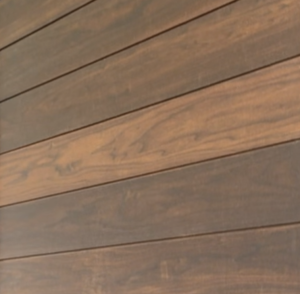
Thermory Benchmark Ash is the flagship hardwood product in Thermory's cladding and decking lineup — a thermally modified White Ash that sets the benchmark for what modified domestic hardwoods can achieve in exterior applications. Sourced responsibly from naturally renewing North American and Northern European forests, the ash is transformed through Thermory's proprietary "Intense" thermal modification process at 215°C (419°F) using only heat and steam. No chemicals, plastics, or additives are introduced at any stage — the transformation is purely physical, altering the wood's cell structure to permanently eliminate the food source for fungi and insects while dramatically reducing the board's ability to absorb moisture.
The result is a stunningly beautiful hardwood with an exotic, deep chocolate-brown color that runs consistently through the entire board — not a surface stain that can chip or wear away. Because the color is produced by molecular caramelization during modification, whenever the board is milled, cut, or sanded, the same rich brown tone remains visible. Thermory Benchmark Ash carries Durability Class 1 ratings under EN 350 — the highest possible durability class — with proven rot resistance for 25+ years in exterior applications, placing it in the same durability tier as tropical hardwoods like teak and ipe, but sourced sustainably from managed North American and European forests.
The performance advantages are substantial: equilibrium moisture content drops to just 4–7% (versus 18–22% for untreated ash), radial and tangential swelling are cut to under 3%, and Janka hardness measures approximately 4,450 N. Because the wood is naturally hydrophobic post-modification, it twists, cups, and bends significantly less than untreated hardwood — critical for the tight, gap-free seams demanded by modern architectural cladding profiles.
Each board is finished with Vivid Walnut Stain, a penetrating oil engineered to stabilize exterior wood from the inside out. Rather than forming a surface film like paint or varnish, Vivid carries its oils deep into the wood fibers, where they work continuously to slow moisture movement — the primary cause of cupping, checking, and end-splitting. Because the finish penetrates rather than coats, it cannot peel or flake, and maintenance requires no sanding or stripping — just clean the surface and reapply when it looks dry.
Ideal for premium architectural siding, cladding, soffits, porch ceilings, feature walls, decking, and porch flooring where the aesthetic warmth of exotic hardwood is desired alongside the sustainability and performance credentials of a domestically modified species.
| Spec | Detail |
|---|---|
| Species | White Ash (Fraxinus americana / Fraxinus spp.) — thermally modified |
| Product Line | Thermory Benchmark Ash |
| Modification Level | Intense — 215°C (419°F) thermal modification, heat and steam only |
| Origin | North America and Northern Europe (sustainably managed forests) |
| Finish | Vivid Walnut Stain |
| Finish Type | Oil-based, non-film-forming |
| Color | Rich, exotic chocolate brown; consistent through full board thickness |
| Weathering | Silvers to gray patina over time if not maintained with colortone |
| Durability Class | Class 1 ("very durable") per EN 350 — highest possible rating |
| Use Class | 3.2 — exterior, above ground, exposed to prolonged wetting conditions (EN 335) |
| Fire Rating | D-s1, d0 (EN 13501-1); Class B flame spread achievable per ASTM E84 |
| Janka Hardness | 4,450 N (~1,000 lbf) |
| Brinell Hardness | 35.6 N/mm² |
| Bending Strength (MOR) | 58.6 N/mm² |
| Modulus of Elasticity | 15,535 N/mm² |
| Compressive Strength | 80 N/mm² |
| Oven-Dry Density | 581 kg/m³ |
| Initial Moisture Content | 6.7% ± 2% |
| Equilibrium Moisture Content | 4% at RH 35%; 6.6% at RH 60%; 10.9% at RH 90% |
| Radial Swelling (35→90% RH) | 0.9% → 2.9% |
| Tangential Swelling (35→90% RH) | 1.6% → 3.3% |
| Screw Traction Resistance | 29.9 N/mm² |
| Grade | Select |
| Warranty | 25+ years rot resistance (Thermory) |
| Standard Lengths | 0.8 – 3.9 m (cladding); 0.8 – 3.9+ m (decking) |
| Applications | Premium exterior siding, cladding, soffits, porch ceilings, feature walls, decking, porch flooring, architectural millwork |
| Fixings | Stainless steel required (FG Screws or PaCS Clad clips recommended); pre-drilling advised |
| Maintenance | Clean and re-oil with Cutek Extreme as needed — no sanding or stripping required |
| Sustainability | Chemical-free modification; sustainable alternative to tropical hardwoods; sourced from managed forests |
| Environmental | EPD available; GWP-Biogenic A1-A3: -5.66E1 kg CO₂e/m³ (net-negative embodied carbon) |
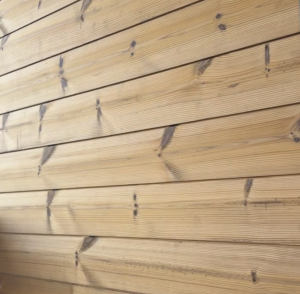
Thermory Knotty Pine is Scandinavian pine transformed through a chemical-free thermal modification process that uses only heat and steam. Sustained temperatures above 190°C fundamentally alter the wood's cell structure, driving off moisture and breaking down the organic compounds that fungi and insects feed on. The result is a dimensionally stable, rot-resistant board with a warm, deepened caramel tone and the character-rich knots that give knotty pine its signature appeal (Thermory).
To preserve that warm color and extend the wood's outdoor service life, each board is finished with CUTEK® Extreme Clear, a penetrating oil that soaks deep into the wood fibers rather than forming a surface film. Because CUTEK® works from the inside out, it stabilizes the board against moisture movement — the leading cause of cupping, splitting, and checking — without peeling or flaking like traditional coatings. The clear formulation contains no pigment, so the wood will naturally silver over time while remaining fully protected. Maintenance is straightforward: no sanding or stripping required, just a clean and re-oil when the surface begins to dry out (CUTEK®).
Ideal for exterior siding, soffits, ceilings, porch cladding, and covered outdoor living spaces where you want the authentic look of natural wood with modern durability.
| Spec | Detail |
|---|---|
| Species | Scandinavian Pine (thermally modified) |
| Product Line | Thermory Knotty Pine |
| Modification | Thermo-D (chemical-free, heat + steam) |
| Grade | Knotty / character grade |
| Finish | Cutek Extreme Clear (penetrating oil) |
| Finish Type | Oil-based, non-film-forming |
| Color | Warm caramel brown (weathers to silver-gray if left untreated over time) |
| Rot Resistance | Class 1 (highest durability class per EN 350) |
| Dimensional Stability | Significantly improved vs. untreated pine |
| Warranty | 25-year limited warranty against rot and decay (Thermory) |
| Applications | Exterior siding, soffits, porch ceilings, covered decks, cladding, outdoor living spaces |
| Maintenance | Clean and re-oil with CUTEK® Extreme as needed — no sanding or stripping required |
| Sustainability | FSC-certified options available; chemical-free modification process |
| Origin | Sourced and modified in Estonia / Northern Europe |
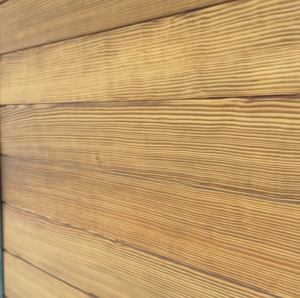
Vertical Grain (VG) Pine is a premium cut of pine milled specifically so that the growth rings run perpendicular to the face of the board — typically at 60° to 90° to the surface. This "quartersawn" or "rift-sawn" orientation produces a board with a tight, straight, pinstripe-like grain pattern that is dramatically more stable and refined than standard flat-sawn (plain-sawn) pine. Because the growth rings are oriented vertically, VG boards resist the cupping, twisting, and cathedral-pattern grain shifts that flat-sawn lumber is prone to, and they wear more evenly over time — which is why vertical grain has been the traditional choice for high-end architectural applications like porch flooring, exterior siding, boat decks, and fine millwork.
The visual character of VG Pine is one of its biggest selling points: consistent, linear grain lines with minimal figure or knots, producing a clean, understated appearance that reads as more formal and architectural than character-grade pine. This makes it particularly well-suited to applications where the wood is a design feature rather than a background material — traditional porch ceilings, Craftsman and coastal-style siding, wainscoting, and interior paneling.
Each board is finished with CUTEK® Extreme Clear, a penetrating oil engineered to stabilize exterior wood from the inside out. Rather than forming a surface film like paint or varnish, Cutek carries its oils deep into the wood fibers, where they work continuously to slow moisture movement — the primary driver of cupping, checking, and end-splitting. This is especially valuable for pine, which is more naturally susceptible to moisture-related movement than denser hardwoods; CUTEK®'s stabilizing action significantly extends the board's dimensional life outdoors. Because the finish penetrates rather than coats, it cannot peel or flake, and maintenance requires no sanding or stripping — just clean the surface and reapply when it looks dry. The clear formulation adds no pigment, allowing the natural honey-gold tone of the pine to show through initially before gradually silvering to a soft gray patina if left unmaintained with a colortone.
Ideal for porch ceilings, tongue-and-groove soffits, traditional lap or shiplap siding, wainscoting, interior paneling, and any application where a refined, straight-grained wood aesthetic is desired.
| Spec | Detail |
|---|---|
| Species | Pine (typically Southern Yellow Pine, White Pine, or Radiata Pine depending on source) |
| Cut | Vertical Grain (VG) — quartersawn / rift-sawn |
| Grain Orientation | Growth rings at 60°–90° to the face; tight, straight, linear grain pattern |
| Grade | Clear or C & Better — minimal knots, uniform appearance |
| Finish | CUTEK® Extreme Clear (penetrating oil) |
| Finish Type | Oil-based, non-film-forming |
| Color | Natural honey-gold to warm amber (weathers to silver-gray if not maintained with colortone) |
| Janka Hardness | ~380–870 lbf depending on pine species |
| Dimensional Stability | Superior to flat-sawn pine — VG cut significantly reduces cupping, twisting, and radial movement |
| Wear Characteristics | Wears more evenly than flat-sawn; ideal for high-traffic and high-visibility applications |
| Applications | Porch ceilings, soffits, T&G siding, wainscoting, interior paneling, fine millwork, traditional and coastal architecture |
| Maintenance | Clean and re-oil with Cutek Extreme as needed — no sanding or stripping required |
| Fixings | Stainless steel or hot-dipped galvanized fasteners recommended for exterior applications |
| Sustainability | Sourced from managed pine forests; FSC-certified options available |